Presidio (FTW): a post-SPAC that pays 14% and almost nobody is watching

Oct 7, 20268 min read
Sergey Monin, Author
Disclosure: I own 15,300 FTW warrants (strike $11.50). This is my own analysis, not investment advice. Figures come from Presidio's SEC filings. Where a number is my own arithmetic, I say so.
I think it deserves a closer look, with a clear view of what holds the thesis together and what could break it.

A business built around not drilling
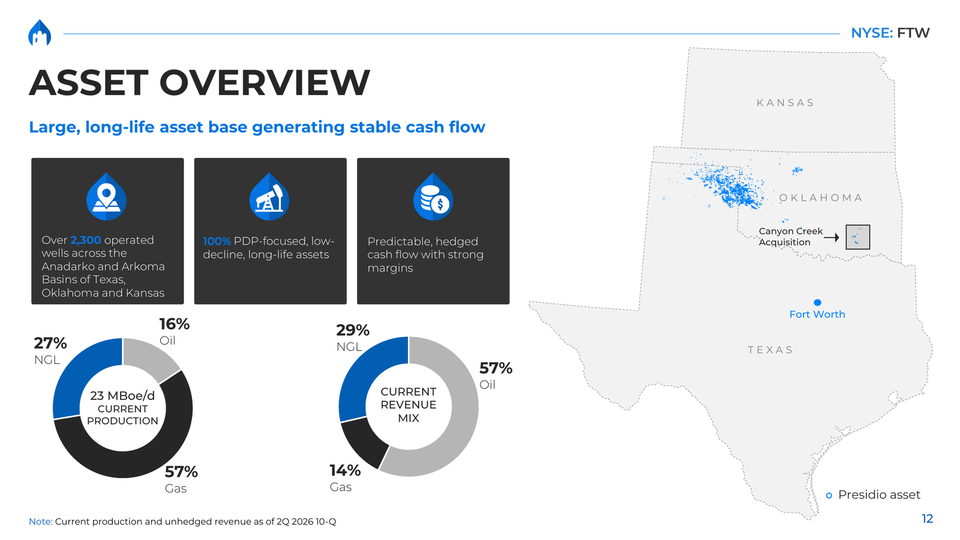
Presidio buys producing oil and gas wells and runs them for cash. It operates more than 2,300 wells across the Anadarko and Arkoma basins, and the company describes its asset base as entirely proved developed producing. In its latest investor presentation, second-quarter production was 23 thousand barrels of oil equivalent per day, made up of 16% oil, 57% natural gas and 27% natural gas liquids.
That mix matters. This is mostly a gas and liquids producer, not an oil bet, and the model has no exploration step where a dry hole can ruin a year. The risks are elsewhere: how fast the wells decline, what the company pays for new ones, and how it finances them.
In the second quarter the company reported $54.0 million of revenue, $33.2 million of adjusted EBITDA and $14.4 million of net income attributable to Presidio. Operating costs ran $11.22 per barrel of oil equivalent, against a realized price of $29.24 including hedges.
Decline rate is the number that matters
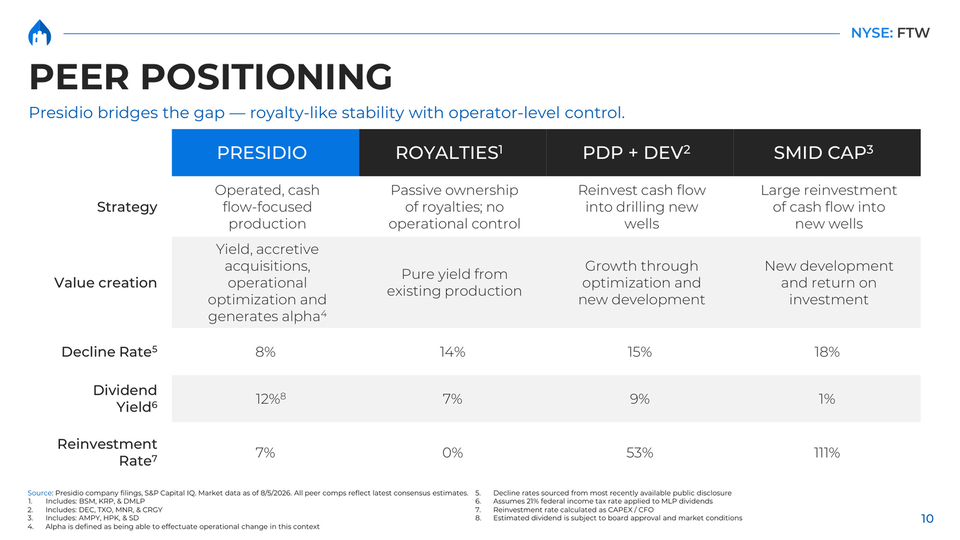
A producing-asset company lives or dies on decline. Every barrel that a well stops producing has to be replaced, either by buying more wells or by squeezing more out of the ones you own. Presidio reports a base decline of about 8%. The presentation compares that with 14% for royalty companies, 15% for producers that combine PDP assets with development, and 18% for small and mid-cap E&Ps.
The same slide shows how little the company reinvests to hold production there. Its reinvestment rate is 7%, compared with 53% for the PDP-plus-development group and 111% for small and mid-cap E&Ps. The practical result is that most operating cash flow is available to pay down debt, service the preferred stock and pay the dividend instead of going back into the ground.
Management also argues it can grow production without capital spending. A new unit, FTW Technologies, runs what the company calls well surveillance and production intelligence, with a 24/7 monitoring tool deployed to its operators and engineers. The 2026 target is 3% to 5% production growth with no capital expenditure, and the company says it has reached 2.3% so far this year. These are management's figures and I haven't been able to verify them independently, but they are specific and checkable, and the third-quarter report will show whether the trend continues.
The financing: asset-backed debt on the wells
Presidio funds acquisitions with asset-backed securities secured by the wells instead of relying on a bank revolver. In the second quarter it refinanced a $350 million ABS issue, bringing the weighted average coupon to 6.38%, 184 basis points lower than before. It also has a $1.0 billion committed ABS warehouse facility, of which $55 million was drawn to fund the Canyon Creek acquisition.
Canyon Creek, an Arkoma Basin acquisition of about $83 million, closed on July 1, 2026. It gives the company an operated position in a second basin, and the presentation says the company assumed field operatorship on day one. Management has tied the planned increase in the annual dividend, from $1.35 to $1.50 per share, to Canyon Creek's contribution.
Asset-backed debt has a feature that is easy to overlook. These notes amortize, so principal is repaid out of cash flow each year instead of at maturity. At June 30 the company had $343.1 million of total debt, of which $35.8 million was due within twelve months. That scheduled repayment has to be covered before any cash reaches shareholders.
Who put money in at the merger
The deal raised about $350 million of preferred and common equity. The common portion included roughly $85 million of PIPE investment anchored by a large integrated energy company and other institutions. Separately, about $65 million came from existing Presidio holders rolling their stakes into the new company, including roughly $40 million from management and $25 million from funds managed by Morgan Stanley Energy Partners. Rollover is not new cash, but it does mean management's wealth is tied to the same shares everyone else owns.
What the dividend really costs
At $9.74, a $1.35 dividend is a 13.9% yield. The presentation shows 12% at its $11.39 reference price, against 7% for royalty companies and 9% for the PDP-plus-development group. A yield that far above its peers should make you suspicious, and the right question is how much cash is left after everything senior to the common stock has been paid.
Here is my own rough arithmetic, using second-quarter adjusted EBITDA annualized to about $133 million. That figure does not include any contribution from Canyon Creek. Interest on about $343 million of debt at roughly 6.4% comes to about $22 million. The company has two series of preferred stock outstanding, a Series A with $112.1 million of liquidation value and a convertible Series B with $24.7 million, both carrying dividends of roughly 8%, which is about $11 million a year. Reinvestment at the reported 7% rate is probably under $10 million. That leaves around $90 million before debt repayment. Scheduled principal of about $36 million takes it to roughly $54 million, and the common dividend at $1.35 on about 33 million shares costs around $45 million.
So the dividend is covered, but by about 1.2 times after principal repayment, not by the wide margin the headline yield implies. This is the number I will watch each quarter. Higher production from Canyon Creek, lower interest from the refinancing, and a $1.50 payout that the company says is supported by the acquisition would all show up in it.
One more item distorts this year's reported figures. The 10-Q shows net cash used in operating activities of $97.9 million for the post-merger period, largely because the company paid $92.8 million to modify its derivative contracts. That looks like a one-time cost of setting up the hedge book at closing, but it means reported operating cash flow for 2026 is not a clean guide to what the business generates.
Hedges and the oil price
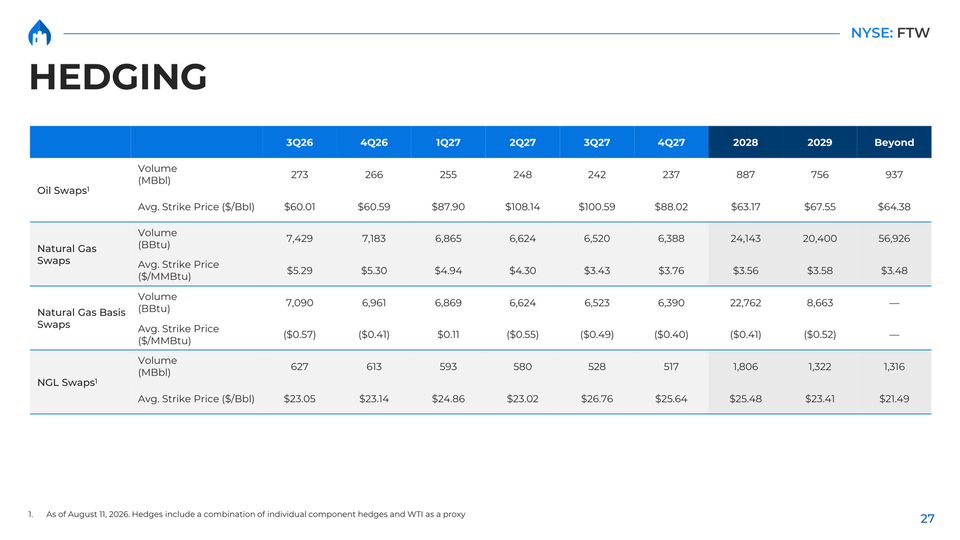
The swaps run well past this year. For 2028 and beyond, 887,000 barrels of oil are hedged at $63.17 and another 756,000 at $67.55, and 24,143 BBtu of natural gas at $3.56 per MMBtu. Crude is currently far above those levels, with WTI near $90 and Brent near $101 at the time of writing.
The consequence is asymmetric. If oil fell sharply, Presidio's cash flow would be largely protected. With oil this high, it benefits less than an unhedged producer would, and the hedge book carries mark-to-market liabilities. That is the trade the company chose: stable cash flow in exchange for giving up much of the upside. A high oil price does one other thing that matters for the strategy. It makes the next acquisition more expensive, and the company says it is looking at a pipeline of about $17 billion of potential deals. Growth depends on finding purchases that still make sense at current prices.
Why the stock has been falling
The second quarter beat the company's own guidance by about 11%, so I don't see evidence of a fundamental problem behind the decline. The selling pressure has technical sources instead.
The company has registered up to 24.2 million Class A shares for resale by existing holders, which is large relative to the roughly 27.7 million Class A shares counted in the presentation. Affiliates of EQV Resources distributed 3.4 million shares on September 9 and now report owning none. And with the stock below the $11.50 exercise price of the warrants, a number of holders have little reason to keep them. None of this says anything about the cash flow of the wells. It does explain why a stock can drift lower for months while the business keeps reporting.
Valuation
The presentation's enterprise value bridge at its $11.39 reference price adds $377 million of equity to $351.5 million of net debt and $125 million of preferred, for $853 million. At $9.74, equity falls to about $322 million and enterprise value to about $799 million, or roughly six times annualized second-quarter EBITDA, again by my arithmetic. For a producer with an 8% decline rate and a long hedge book, that is a low multiple. BTIG initiated coverage with a Buy rating and a $15 price target. Net debt is 2.7 times annualized EBITDA, which is moderate but not small, and the preferred stock sits in front of the common shares.
What could go wrong
The balance sheet comes first. Roughly $351 million of net debt and about $137 million of preferred are senior to the common stock, and the dividend is paid at the board's discretion. The company says plainly that it can be adjusted, suspended or discontinued. With coverage near 1.2 times after principal, a weaker quarter could force a choice between the dividend and the debt schedule.
Integration is the next risk. The presentation lists legal proceedings relating to Canyon Creek among its risk factors, and the integration is only a few months old. A model that relies on buying assets and cutting operating costs is only as good as its execution on each deal.
The model also depends on continuing acquisitions or optimization to offset decline. An 8% base decline is excellent, but it is still a decline. If deals stop or the AI-driven uplift stalls, production falls and the dividend has less behind it.
Finally, liquidity is thin. At 85,000 shares a day, a position of any size takes patience to build and to exit, and the resale overhang may continue to weigh on the price until those holders are finished selling.
A word on the warrants
I hold warrants and not only shares, and the two are different bets. Each warrant is exercisable for one Class A share at $11.50 and expires five years after the closing, around March 2031. The company may redeem them for $0.01 if the stock closes at or above $18 for 20 of 30 trading days. At $9.74 the stock must rise about 18% before a warrant is worth anything on exercise, so the value today is time value only. If the thesis plays out, the warrants should amplify it. If the dividend is cut or a deal goes wrong, they will fall faster than the common stock.
What I'm watching
The third-quarter report will show production after Canyon Creek, whether the dividend moves to $1.50, and how much the AI program has delivered toward its 3% to 5% target. I'll be looking at dividend coverage after principal repayment, at the next acquisition and the price paid relative to oil, and at whether resale selling slows. If those line up, a company this lightly followed could look very different in a year.
Sources: Q2 2026 investor presentation; Form 10-Q for the quarter ended June 30, 2026; business combination press release; resale prospectus.


Check it against the live data.
Everything referenced here comes from filings, and the aggregate figures are public.
No comments yet
Loading the discussion…